"Coup in Ecuador?
by Kristin Bricker
September 30, hundreds agents of the Ecuadorian National Police took to the streets, blocking key intersections and occupying public space, to protest a new law that eliminates their bonuses and other benefits.
Although the Police protest represented a small fraction force 42,000 members, the situation quickly went out of control. Police occupied the National Assembly, helped close the airports, and Correa held hostage in a hospital for more than 10 hours until a Special Operations team rescued him. The riots left 10 dead and 274 wounded.
The rebellion began after the police that Correa used the veto to modify parts of the Public Service Act, which apparently had the objective of streamlining the public sector in Ecuador by removing some grants and forcing many civil servants to retire early. The president's veto power is provided the 2008 Constitution and the president has often been used to clear the Assembly.
According to Edwin Bedoya, vice president of the Ecuadorian Confederation of United Workers Class Organizations (CEDOCUT) version of the Public Service Act passed by the Assembly was originally developed in the negotiations between Correa's Alianza PAIS party and social sectors. "But we saw in the second round of voting that the President had vetoed the agreement and had taken away the rights of workers," said Bedoya. When the Assembly including some members of Alianza PAIS, resisted Correa changes in legislation, the president threatened to use his right to dissolve the Assembly to approve its version of the Public Service Act.
But the rebellion that ensued, Correa and others have emphasized, it was not a spontaneous uprising. While still being held hostage, Correa said: "It's a coup attempt led by the opposition and some sections of the armed forces and police." Many Latin Americans, still surprised by the coup against leftist President Manuel Zelaya in Honduras last year, it was feared that belt out the next. Other argued that calling the riots a "coup" is an exaggeration, and even self Correa has been kidnapped in order to increase his popularity and political power.
However, protests were held in at least four departments in Ecuador, calling into question its spontaneity. As noted Correa, the protests were "coordinated with the closure... The airport, coordinated with the attacks on the relay satellite television [state], with the invasion of Ecuador TV Studies [government-owned ] "and takes the Assembly by the police.
Moreover, videos taken from the police Striking at the time of the operation that freed Correa clearly demonstrates that the police were shooting to kill. Correa told reporters that the armored vehicle that took him away from the hospital was shot several times .
Although police hostage Correa, former Ecuadorian president Lucio Gutiérrez-Correa critic gave interviews from Brazil, highlighting the rebellion of the police as a coup. "The end of the tyranny of Correa is near" said, calling for the dissolution of Parliament "and" early presidential elections. " The former president's CRAFTSMANSHIP, Alberto Acosta, a follower of Correa became critic, reported that "former soldiers and ex-cop, the same people that make up the party's strength by Lucio," were seen in barracks in several cities. When police briefly occupied the Assembly, said Acosta, representatives who are members of Gutierrez's Patriotic Society Party came and went freely, while members of other parties "had trouble getting into."
Both Correa and the former National Police commander Freddy Martinez, who resigned after being unable to maintain control of their troops, they argue that external instigators infiltrated the police, the police tricked its austerity measures in the Public Service Act, and caused a riot.
labor and indigenous organizations in Ecuador, however, have adopted a more regulated. Rise of the police came, they said, because the right of Ecuador is taking advantage of the weaknesses created by the government alienating Correa style. Although opposed any coup attempt and demanded to respect the constitutional order, Correa also criticized for alienating his natural allies in social movements and remain vulnerable to attacks from the right.
A joint statement from four of the largest organizations Ecuador Indians rejected "the actions of the right to covert part of the coup attempt" and urged its members to "be alert and ready to move." However, the statement criticized Correa's government violently suppress demonstrations against transnational mining, oil and agro-industrial enterprises. The organizations argued that "the social crisis that was released today was caused also by the authoritarian nature and the lack of willingness for dialogue in the legislative process. We have seen how the laws that have been negotiated [with the social sectors] were vetoed by the President of the Republic. . . . This scenario is nurtured by conservatives. "
Union leader Bedoya says that on 30 September, CEDOCUT called on all sectors to take to the streets to restore constitutional order. However, as indigenous organizations in their country, called your organization with a defense of Correa: "We believe that part of the blame for what is happening lies in a refusal to dialogue with the social sectors."
Acosta, who co-founded the Alianza PAIS with Correa, echoes this. "The president and his government does not know how the dialogue, "he said." They impose its laws, without even respecting the criteria for the assembly of its own block. "
Worse, indigenous organizations argued the day of the coup, the Correa government has cracked down just as it has the right-wing governments. "Faced with criticism and mobilization of communities against transnational mining, oil and agro-industrial enterprises," wrote CONAIE ECUARUNARI, CONFENIAE and CONAICE , "the government, rather than creating a dialogue, responds with violence and repression.... The only thing that causes this type of policy is to open spaces to the right and create opportunities for destabilization. "Bedoya
shares this analysis:" Of course, the right takes advantage of this, and takes advantage of more sector powerful, which is the national police and military, and begins to sow discontent. . . but the government's behavior makes it possible. "
Acosta hopes his former ally learn from the rebellion of the police." History has given to President Correa, once again, the opportunity to rediscover the origins of the revolutionary process to rectify. Hopefully you understand it that way. "
" A citizen revolution, "says Bedoya," implies respect for the rights of all people, workers, collective rights organizations, and has established a dialogue bring to a conclusion with the social sectors. "
This article was translated from English. The quotes in this article (for example, Lord Bedoya) were translated into English for the original article, then returned to be translated into English for this translation. Then, the quotations are not the exact words of the persons named, but they do represent what they meant. In many cases, you can click on the links to find the exact words of the persons mentioned.
Monday, October 18, 2010
Thursday, October 7, 2010
Flowers That Go With Burgundy Dresses
corruption and deforestation cause mudslide disaster in Oaxaca Autonomous Authorities
by Kristin Bricker
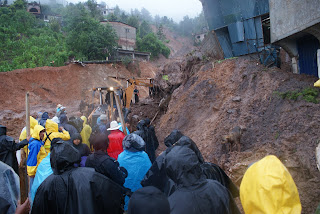
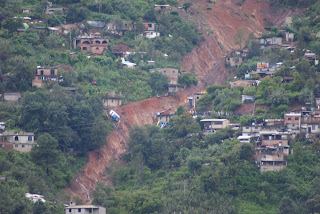
On the morning of Tuesday 28 September the world awoke to the news that a landslide had buried land 80% of Tlahuitoltepec, Oaxaca, a town of 10,000 people. Weeping Tlahuitoltepec officials told reporters that around 300 to 500 people may have been buried under the mud, while the Oaxaca governor Ulises Ruiz Ortiz placed the number of potential deaths "up to 1.000". The federal government deployed soldiers and federal police to the area, and even the United States offered its assistance in digging Tlahuitoltepec residents.
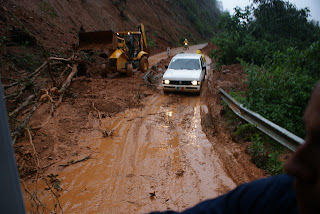
When rescuers arrived Tlahuitoltepec after more than ten hours of delay by the poor condition of roads in the state, they realized that the landslide was not as bad as they thought. The avalanche left eleven dead.
Disaster Predictably, highlighting the fatal consequences of the notorious corruption present in the state's public works.
Deforestation
The 2010 hurricane season has caused record rainfall in southern Mexico, resulting in floods, landslides, and deaths in several states, including Oaxaca.
A report published by the Council of Mineral Resources of the federal government in 2001, warned that as a result of deforestation, is regularly Tlahuitoltepec large landslides during hurricane season. The report, entitled "Natural Hazards", warned that landslides in Tlahuitoltepec tend to affect both roads, as the houses. The government has done nothing to solve the problem of landslides in Tlahuitoltepec, where residents live on hillsides.
The mudslide that shocked the world on September 28 did not happen overnight. The mud began to creep on September 13, causing the walls of nearby houses began to agrietare landslide at the time the earth began to move. At that time, Civil Protection told the mayor that the town was evacuated. However, neither the state nor federal government seems to have helped in the evacuation, even the residents were offered shelter Tlahuitoltepec. It was only after local officials apparently exaggerated the extent of the landslide on 28 September that the state police began escorting residents Tlahuitoltepec.
As rescue crews assessed the situation in the Mixe Indian region (which is located Tlahuioltepec), they will decide whether to evacuate 30,000 people. "In that area during heavy rains. The ground is unstable and could be more landslides," said Oaxaca Governor Ulises Ruiz to El Universal. "It is better to act, because anything can happen."
Oaxaca Highway paved with corruption
Unfortunately, Governor Ruiz decided to act only when Tlahuitoltepec officials exaggerated the Sept. 28 runoff. Local authorities have warned the state government that landslides could cause a humanitarian catastrophe, since August when they complained that 50% of roads in the region were damaged. "If not repaired, we run the risk that many people would be completely inaccessible in the coming days," said state Rep. Floriberto Vásquez Vásquez, the state government and the press. The state government ignored their pleas.
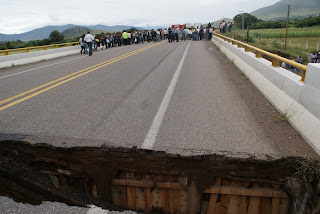
On September 8, warnings Vasquez became a reality. That day, an official the state of Oaxaca reported that 80% of 22.000 km of state highways were damaged by landslides and poor quality of buildings, held incommunicado for more than thirty communities outside world. The mixes was one of the most affected regions.
roads and landing strips of Oaxaca (CAO), the state agency responsible for road construction and maintenance of Oaxaca, responded to concerns about the deplorable road conditions, saying that could not be repaired because no budget had more money . Daily, a newspaper in Oaxaca who openly supports the ruling party of state, wrote in an opinion piece:
Public officials often give no-bid construction contracts to friends and party colleagues. The citizens suspect that funds many of these contracts are used to finance political campaigns. Such is the case in Salina Cruz, Oaxaca, where Jesus Mortera Hiram financed his campaign for municipal office with earnings from public works projects. Two mayors was granted on most public works contracts in the city. The government is carrying out an audit of the two former mayors for alleged misappropriation of funds through construction projects Mortera. Of particular concern is the "rehabilitation" of a four-lane road Mortera in Salina Cruz. The road has collapsed three times since the "rehabilitation" that made Mortera.
So far nobody has shown that politicians and contractors Oaxaca embezzle money from road projects using inexpensive materials and pocketing the difference. In 2008, State auditors concluded that Carlos Alberto Ramos Aragon used a project to build a boulevard to embezzle money when he served as mayor of Pinotepa Nacional, Oaxaca, but never found out exactly how: Ramos Aragón simply not delivered the receipts to the auditors. Ramos Aragon was never punished for this alleged embezzlement. He currently serves as director of the Institute of Civil Protection of the State of Oaxaca, one of the agencies in charge of rescue efforts in Tlahuitoltepec.
Although details on how the politicians misappropriate money for road projects are complete or are vague with no evidence of a recent scandal in the federal program "Strong Flats," shows how many Oaxacan suspect that the contractors and the politicians are stealing money from road projects. The federal government provides funds to states like Oaxaca through the project "cement floors, concrete floors to install in homes with dirt floors. The federal government calculates the amount of cement that is sent to the states, based on the amount and size of households receiving the new apartments through this program. In Guerrero, another state that receives cement through "cement floors, an audit found that federal state and local politicians diluted donated cement with sand, which is cheaper, so unless it was necessary to install concrete floors. The beneficiaries were left with low-quality flats, while local politicians sold the excess cement. Guerrero politicians and contractors had misappropriated $ 149 million dollars through fraud, according to federal audit.
Some Oaxacan communities are demanding a similar audit of the "cement floors in your state. The residents say that local politicians are using the same scheme to offer less cement to beneficiaries, and that politicians excess cement exchange for votes. Furious residents say politicians also paid to workers by the installation of soil than half of what the federal government has budgeted for their wages, and that politicians are pocketing the other half.
While audits have not yet discovered embezzlement schemes related to the materials used to build poorly constructed road course in Oaxaca, the projects "ghosts" of roads are common. Ghosts in the projects, the government pays for a road to be built or paved. Local officials say the project was completed and collected the money, but in reality the project even starts. Only last August, the federal government dismissed nine officials for embezzling Oaxaca $ 930,000 pesos by the ghosts of roads projects. In April, authorities in sixty communities in San Juan Mixtepec marched in protest of alleged embezzlement of funds from the mayor of $ 10 million dollars in federal funds through ghost projects of roads, bridges and water projects.
The consequences of corruption and misappropriation of funds in public works is costly and deadly, as evidenced by the Tlahuitoltepec disaster. Exaggerated reports about the magnitude of the landslide circulated for more than ten hours before the first rescue teams could reach the devastated town, located just two hours from the city of Oaxaca. The first rescue team arrived on foot because roads were impassable. Heavy equipment such as bulldozers came much later. While the world watched in horror as roads and collapsed bridges delayed rescuers and equipment, no one in Oaxaca was surprised because the bad conditions of roads have become a fact of everyday life.
While the massive loss of life seems to have been avoided in Tlahuitoltepec, land runoff should serve as a warning to state and federal government, that greater oversight and accountability accounts are necessary to avoid a future catastrophe.
by Kristin Bricker
On the morning of Tuesday 28 September the world awoke to the news that a landslide had buried land 80% of Tlahuitoltepec, Oaxaca, a town of 10,000 people. Weeping Tlahuitoltepec officials told reporters that around 300 to 500 people may have been buried under the mud, while the Oaxaca governor Ulises Ruiz Ortiz placed the number of potential deaths "up to 1.000". The federal government deployed soldiers and federal police to the area, and even the United States offered its assistance in digging Tlahuitoltepec residents.
When rescuers arrived Tlahuitoltepec after more than ten hours of delay by the poor condition of roads in the state, they realized that the landslide was not as bad as they thought. The avalanche left eleven dead.
Disaster Predictably, highlighting the fatal consequences of the notorious corruption present in the state's public works.
Deforestation
The 2010 hurricane season has caused record rainfall in southern Mexico, resulting in floods, landslides, and deaths in several states, including Oaxaca.
A report published by the Council of Mineral Resources of the federal government in 2001, warned that as a result of deforestation, is regularly Tlahuitoltepec large landslides during hurricane season. The report, entitled "Natural Hazards", warned that landslides in Tlahuitoltepec tend to affect both roads, as the houses. The government has done nothing to solve the problem of landslides in Tlahuitoltepec, where residents live on hillsides.
The mudslide that shocked the world on September 28 did not happen overnight. The mud began to creep on September 13, causing the walls of nearby houses began to agrietare landslide at the time the earth began to move. At that time, Civil Protection told the mayor that the town was evacuated. However, neither the state nor federal government seems to have helped in the evacuation, even the residents were offered shelter Tlahuitoltepec. It was only after local officials apparently exaggerated the extent of the landslide on 28 September that the state police began escorting residents Tlahuitoltepec.
As rescue crews assessed the situation in the Mixe Indian region (which is located Tlahuioltepec), they will decide whether to evacuate 30,000 people. "In that area during heavy rains. The ground is unstable and could be more landslides," said Oaxaca Governor Ulises Ruiz to El Universal. "It is better to act, because anything can happen."
Oaxaca Highway paved with corruption
On September 8, warnings Vasquez became a reality. That day, an official the state of Oaxaca reported that 80% of 22.000 km of state highways were damaged by landslides and poor quality of buildings, held incommunicado for more than thirty communities outside world. The mixes was one of the most affected regions.
roads and landing strips of Oaxaca (CAO), the state agency responsible for road construction and maintenance of Oaxaca, responded to concerns about the deplorable road conditions, saying that could not be repaired because no budget had more money . Daily, a newspaper in Oaxaca who openly supports the ruling party of state, wrote in an opinion piece:
"... Are striking statements of officials of CAO in the sense that" no resources "to fix 80 percent of damaged roads have now Oaxaca, but then one wonders why the CAO holds an annual ... subejercicio millionaire resources. That gentlemen, is called incompetence. If there are dozens of communities cut off by landslides and the road network desgalamiento is a priority to manage the money as is necessary to remedy the situation .... It audits need to be done ... because it happens that, despite the release of resources, they do not reach those affected most of the time ... What Whose hands are left? "Complaints about corruption in road projects and other projects in Oaxaca are adiaro.'s suspicions arising from the high costs and poor results. Some roads are crumbling in cuentón of months.
Public officials often give no-bid construction contracts to friends and party colleagues. The citizens suspect that funds many of these contracts are used to finance political campaigns. Such is the case in Salina Cruz, Oaxaca, where Jesus Mortera Hiram financed his campaign for municipal office with earnings from public works projects. Two mayors was granted on most public works contracts in the city. The government is carrying out an audit of the two former mayors for alleged misappropriation of funds through construction projects Mortera. Of particular concern is the "rehabilitation" of a four-lane road Mortera in Salina Cruz. The road has collapsed three times since the "rehabilitation" that made Mortera.
So far nobody has shown that politicians and contractors Oaxaca embezzle money from road projects using inexpensive materials and pocketing the difference. In 2008, State auditors concluded that Carlos Alberto Ramos Aragon used a project to build a boulevard to embezzle money when he served as mayor of Pinotepa Nacional, Oaxaca, but never found out exactly how: Ramos Aragón simply not delivered the receipts to the auditors. Ramos Aragon was never punished for this alleged embezzlement. He currently serves as director of the Institute of Civil Protection of the State of Oaxaca, one of the agencies in charge of rescue efforts in Tlahuitoltepec.
Although details on how the politicians misappropriate money for road projects are complete or are vague with no evidence of a recent scandal in the federal program "Strong Flats," shows how many Oaxacan suspect that the contractors and the politicians are stealing money from road projects. The federal government provides funds to states like Oaxaca through the project "cement floors, concrete floors to install in homes with dirt floors. The federal government calculates the amount of cement that is sent to the states, based on the amount and size of households receiving the new apartments through this program. In Guerrero, another state that receives cement through "cement floors, an audit found that federal state and local politicians diluted donated cement with sand, which is cheaper, so unless it was necessary to install concrete floors. The beneficiaries were left with low-quality flats, while local politicians sold the excess cement. Guerrero politicians and contractors had misappropriated $ 149 million dollars through fraud, according to federal audit.
Some Oaxacan communities are demanding a similar audit of the "cement floors in your state. The residents say that local politicians are using the same scheme to offer less cement to beneficiaries, and that politicians excess cement exchange for votes. Furious residents say politicians also paid to workers by the installation of soil than half of what the federal government has budgeted for their wages, and that politicians are pocketing the other half.
While audits have not yet discovered embezzlement schemes related to the materials used to build poorly constructed road course in Oaxaca, the projects "ghosts" of roads are common. Ghosts in the projects, the government pays for a road to be built or paved. Local officials say the project was completed and collected the money, but in reality the project even starts. Only last August, the federal government dismissed nine officials for embezzling Oaxaca $ 930,000 pesos by the ghosts of roads projects. In April, authorities in sixty communities in San Juan Mixtepec marched in protest of alleged embezzlement of funds from the mayor of $ 10 million dollars in federal funds through ghost projects of roads, bridges and water projects.
The consequences of corruption and misappropriation of funds in public works is costly and deadly, as evidenced by the Tlahuitoltepec disaster. Exaggerated reports about the magnitude of the landslide circulated for more than ten hours before the first rescue teams could reach the devastated town, located just two hours from the city of Oaxaca. The first rescue team arrived on foot because roads were impassable. Heavy equipment such as bulldozers came much later. While the world watched in horror as roads and collapsed bridges delayed rescuers and equipment, no one in Oaxaca was surprised because the bad conditions of roads have become a fact of everyday life.
While the massive loss of life seems to have been avoided in Tlahuitoltepec, land runoff should serve as a warning to state and federal government, that greater oversight and accountability accounts are necessary to avoid a future catastrophe.
Tuesday, October 5, 2010
My Cat Has Ulcerations On Her Tongue
Labour market and economic models: Past and Present, by Lucas Pucci
Federal Capital (Paco Urondo Agency, Buenos Aires Economico published 10/01/2010)
The evolution of the wage relation in Argentina is closely linked with the models and accumulation regime implemented throughout history, which have significantly influenced the shaping and articulation of the labor market in our country in parallel and also the product of the productive sectors developed.
is from the military dictatorship that the labor market in Argentina began the first process of destruction that will reach its peak in the 90s. During this period, type of openness with economic stagnation, it started developing a reduction in real wages and a gradual decline in formal employment, thus establishing informal sector in an area of \u200b\u200brefuge and survival at the beginning of the process deindustrializing. It is imperative noted that the disintegration of the labor market is done in parallel with the decline of the welfare state who knew articulated during the import substitution, especially during the Peronist period.
The remarkable progress of the capital over the work begins in the military process involves the breaking of patterns of behavior within the traditional industrial relations system product of the abolition of the collective rights of workers, promoting retraction real wages. In turn, a product of the process of deindustrialization that took place, it generated a transfer to self-employed sectors, tertiary and informal parallel to that hidden unemployment rates and withdrawal effects in the labor market.
Thus, upon completion of the structural changes of the dictatorship in the economy and society, in addition to the funding crisis product of external debt in the early 80's, the structure of labor market affected. It is important to note that with the democratic opening, but with the financial crisis on their backs they finished with the hyperinflationary crisis, and industrial equipment destroyed and with little capacity to restructure, is that the structure down and deregulation of the labor market did not change broadly speaking, except for growth feminization of the work product of the economic needs of households and the growth of labor disputes result of the reappearance of the actor and the restoration of union bargaining patterns framed on the model of industrial relations.
From the 90s, and once established and secured the convertibility regime, is observed in the job market a second process of destruction of the labor market characterized from labor reforms "flexible" that according to prevailing neoliberal paradigm seeks to break the rigidity of labor regulations that impede access to employment and productive development and investment. In turn, during this period made significant reforms in the structure of labor and social institutions restricting the ability of state intervention as from trade liberalization, privatization of public enterprises and reducing the price of imports is that it will bring forward a process of deindustrialization that results in an increase in open unemployment, underemployment, informal urban and job insecurity.
This is the time in which consolidated the neoliberal paradigm, thus establishing a break not only in the respective economic policy but also in the role of the state and the institutions that are articulated Through the first. Thus, the various social institutions and sectors that they represent (social security, employment, health, education, etc.) were victims of profound structural changes whose consequences have to return in the living conditions of the population, especially in popular .
therefore articulates a process of economic restructuring from neoliberal policies and subscription to the Washington Consensus, whose stated objectives are to generate structural changes in the economic and social, affecting the state's role, capabilities and functions. An example of this is not only the privatization process of public enterprises but also with regard to regulation of industrial relations, social, educational and health policies, economic openness, financial recovery at the expense of productive capital, and so on. Therefore
, and benefited from the flexibility of labor regulations and the economic restructuring process, it generates a process of transformation in the process of accumulation of large companies in pursuit of lower costs, increase productivity and gain international competitiveness As desverticalizan from input substitution for imports, outsourcing of those inputs with lower productivity, expulsion of labor and employment rationalization, etc., which affects the formation of the labor market.
is interesting to note that the period analyzed, although with a strong process of industrialization that affects mainly small and medium enterprises, also has a growing service sector. However, not only this is not enough to absorb the unemployed labor, but also was an increase in productivity over the product.
If we add context changes on incomes policy, stimulated by the retraction in the industrial relations system and union bargaining power before the advance of capital and more flexible forms of production as is the case of trading by company rather than the historic industry, among which include the downgrading of the value of minimum wage, the definition of salary increases productivity, growth of non-remunerative concepts, ways of outsourced contracts, temporary, shortened and no social security contributions, such as lease of services, given time, internships, through temporary employment agencies, etc..
front grounds, means not only growth unemployment in Argentina but also the growth of urban informal sector, especially in its productive aspect, which becomes part of the logic of accumulation of large enterprises in their attempts to reduce costs, explaining the precarious working conditions for the period. That is why some major changes within the labor market in the process of destruction of the last decade was mainly because the increase in wage employment in the formal registration and the large companies desverticalizaión accompanied by policies rationalization of manpower through cost reduction, expulsion of labor and outsourcing, setting the urban informal system as the main supplier of goods and services in these large companies.
However, from the process that begins with the breakdown of the financial valuation model using the first and devaluation in 2003 with the consolidation of a profile of national development based on industrialization and development of production but at the time focused in the restructuring of work and income of the popular sectors as a determinant for the restructuring of the domestic market is that there is a marked improvement in the labor market based on the sustained fall in unemployment and precarious work.
This reverses the logic established in the second half of the '70s through the development of formal wage sector, which in turn creates an obvious reduction of poverty and destitution in the country that has overcome Global economic crisis successfully last year and that allows it is possible to argue that economic growth, investment and productive development without precarious working conditions.
The above allows us to observe that the labor market is closely linked to economic and development model generated. Consequently, the experiences in the country realize that the development national must be from a sustainable industrialization process that includes the popular sectors and strengthen the state's role to act as Protectoria to work, avoiding any form of precariousness and flexibility in pursuit of strengthening an alliance between capital and work to deploy the productive forces to generate economic growth and full employment for national development.
In contrast, and the other side of the sidewalk, still the remains of the Argentine experience in general and unemployed workers yesterday and today in particular employees know well: the absent state that legitimizes the job insecurity, unemployment and pauperization workers in favor of financial capital and under the support of the neoliberal ideological spillover defended by the Washington Consensus.
The choice between the labor market yesterday and today does not seem difficult.
The author holds a degree in labor relations of the Study Group of National Economy and Popular (GEENaP) www.geenap.com.ar (Paco Agency Urondo)
is from the military dictatorship that the labor market in Argentina began the first process of destruction that will reach its peak in the 90s. During this period, type of openness with economic stagnation, it started developing a reduction in real wages and a gradual decline in formal employment, thus establishing informal sector in an area of \u200b\u200brefuge and survival at the beginning of the process deindustrializing. It is imperative noted that the disintegration of the labor market is done in parallel with the decline of the welfare state who knew articulated during the import substitution, especially during the Peronist period.
The remarkable progress of the capital over the work begins in the military process involves the breaking of patterns of behavior within the traditional industrial relations system product of the abolition of the collective rights of workers, promoting retraction real wages. In turn, a product of the process of deindustrialization that took place, it generated a transfer to self-employed sectors, tertiary and informal parallel to that hidden unemployment rates and withdrawal effects in the labor market.
Thus, upon completion of the structural changes of the dictatorship in the economy and society, in addition to the funding crisis product of external debt in the early 80's, the structure of labor market affected. It is important to note that with the democratic opening, but with the financial crisis on their backs they finished with the hyperinflationary crisis, and industrial equipment destroyed and with little capacity to restructure, is that the structure down and deregulation of the labor market did not change broadly speaking, except for growth feminization of the work product of the economic needs of households and the growth of labor disputes result of the reappearance of the actor and the restoration of union bargaining patterns framed on the model of industrial relations.
From the 90s, and once established and secured the convertibility regime, is observed in the job market a second process of destruction of the labor market characterized from labor reforms "flexible" that according to prevailing neoliberal paradigm seeks to break the rigidity of labor regulations that impede access to employment and productive development and investment. In turn, during this period made significant reforms in the structure of labor and social institutions restricting the ability of state intervention as from trade liberalization, privatization of public enterprises and reducing the price of imports is that it will bring forward a process of deindustrialization that results in an increase in open unemployment, underemployment, informal urban and job insecurity.
This is the time in which consolidated the neoliberal paradigm, thus establishing a break not only in the respective economic policy but also in the role of the state and the institutions that are articulated Through the first. Thus, the various social institutions and sectors that they represent (social security, employment, health, education, etc.) were victims of profound structural changes whose consequences have to return in the living conditions of the population, especially in popular .
therefore articulates a process of economic restructuring from neoliberal policies and subscription to the Washington Consensus, whose stated objectives are to generate structural changes in the economic and social, affecting the state's role, capabilities and functions. An example of this is not only the privatization process of public enterprises but also with regard to regulation of industrial relations, social, educational and health policies, economic openness, financial recovery at the expense of productive capital, and so on. Therefore
, and benefited from the flexibility of labor regulations and the economic restructuring process, it generates a process of transformation in the process of accumulation of large companies in pursuit of lower costs, increase productivity and gain international competitiveness As desverticalizan from input substitution for imports, outsourcing of those inputs with lower productivity, expulsion of labor and employment rationalization, etc., which affects the formation of the labor market.
is interesting to note that the period analyzed, although with a strong process of industrialization that affects mainly small and medium enterprises, also has a growing service sector. However, not only this is not enough to absorb the unemployed labor, but also was an increase in productivity over the product.
If we add context changes on incomes policy, stimulated by the retraction in the industrial relations system and union bargaining power before the advance of capital and more flexible forms of production as is the case of trading by company rather than the historic industry, among which include the downgrading of the value of minimum wage, the definition of salary increases productivity, growth of non-remunerative concepts, ways of outsourced contracts, temporary, shortened and no social security contributions, such as lease of services, given time, internships, through temporary employment agencies, etc..
front grounds, means not only growth unemployment in Argentina but also the growth of urban informal sector, especially in its productive aspect, which becomes part of the logic of accumulation of large enterprises in their attempts to reduce costs, explaining the precarious working conditions for the period. That is why some major changes within the labor market in the process of destruction of the last decade was mainly because the increase in wage employment in the formal registration and the large companies desverticalizaión accompanied by policies rationalization of manpower through cost reduction, expulsion of labor and outsourcing, setting the urban informal system as the main supplier of goods and services in these large companies.
However, from the process that begins with the breakdown of the financial valuation model using the first and devaluation in 2003 with the consolidation of a profile of national development based on industrialization and development of production but at the time focused in the restructuring of work and income of the popular sectors as a determinant for the restructuring of the domestic market is that there is a marked improvement in the labor market based on the sustained fall in unemployment and precarious work.
This reverses the logic established in the second half of the '70s through the development of formal wage sector, which in turn creates an obvious reduction of poverty and destitution in the country that has overcome Global economic crisis successfully last year and that allows it is possible to argue that economic growth, investment and productive development without precarious working conditions.
The above allows us to observe that the labor market is closely linked to economic and development model generated. Consequently, the experiences in the country realize that the development national must be from a sustainable industrialization process that includes the popular sectors and strengthen the state's role to act as Protectoria to work, avoiding any form of precariousness and flexibility in pursuit of strengthening an alliance between capital and work to deploy the productive forces to generate economic growth and full employment for national development.
In contrast, and the other side of the sidewalk, still the remains of the Argentine experience in general and unemployed workers yesterday and today in particular employees know well: the absent state that legitimizes the job insecurity, unemployment and pauperization workers in favor of financial capital and under the support of the neoliberal ideological spillover defended by the Washington Consensus.
The choice between the labor market yesterday and today does not seem difficult.
The author holds a degree in labor relations of the Study Group of National Economy and Popular (GEENaP) www.geenap.com.ar (Paco Agency Urondo)
Monday, October 4, 2010
Messages To Go Inside Cards
1, ACCOUNTING LEGAL WORKSHOP FOR CIVIL PARTNERSHIPS PROVINCIAL SAN FERNANDO 2010
MAP Location:
http://san-fernando-mi-ciudad.blogspot.com/
http://san-fernando-mi-ciudad.blogspot.com/2010/09/1-taller-juridico-contable-para. html
Federal Capital (Paco Urondo Agency) (Agency Paco Urondo)
FBONG
Commission Directive
ASC-CodoACodo
Delegation San Fernando
Contact: 1562732340
CIVIL PARTNERSHIP / COMMISSION DIRECTIVE
The Federation Bonaerense governmental entities and civil partnership "shoulder to shoulder" is pleased to invite you to "1 ACCOUNTING LEGAL WORKSHOP FOR CIVIL PARTNERSHIPS PROVINCIAL SAN FERNANDO 2010 to be held next October 8 at 14:30 Hrs in the Hall La Casona , located on the street Pte Peron 918 Esq Av Sarmiento City of San Fernando. (Four blocks station San Fernando F. Mitre)
In this workshop will address the following agenda:
Ø ; features and differences between the Civil Partnerships I, II, III and IV grade.
Ø Ordinary and Balances.
Ø Extraordinary.
Ø Statute Reform, change of registered office.
Ø a federation, the role of associations in the construction of Social Policy.
Ø Using official records (minutes of meetings of Executive Committee, General Journal, Inventories and Balances, Register of Members, Meeting Minutes).
Ø Registration of associations in the AFIP, form J420, ARBA exceptions.
Ø Preparation of documentation PRE and POST ASSEMBLY.
To close the activity will be given provincial legal personality processed by the FBENG, diplomas training workshop JOURNALISM theoretical and practical and enroll affiliates.
The day count convention with municipal authorities and delegations Provincial District.
Accreditation: Accreditation : Federación_beng@yahoo.com.ar -
Tel: 011-62732340
remain, Sincerely very atte.
MAP Location:
918 Av Presidente Perón and Sarmiento Esq.
La Casona of capacity, are at the heart of San Fernando, 1 block from the main square, the church, the city and a few blocks from the San Fernando Club and Marinas.
Highways:
- Access North: Ramal Tigre down then take Route 202 (marked by Cartel hand toward the river) after passing the level crossing, change its name to the 1000 Ayacucho and turn left onto Avenida del Libertador then to 900, turn left onto Calle Sarmiento 100 Mts. left hand right on the corner of Avenida Perón and Sarmiento.
- Av Pte Perón then continues with the names, Centenario, Santa Fe, Maipu, Cabildo toured North Zone and Federal Capital.
- Del Libertador Avenue, runs parallel to Avenida Presidente Perón, also extends along the North Zone and Federal Capital.
- bus lines within a radius of 200 Mts: 60, 203, 365, 343 and 710
- Train: The train station Mitre line, is 7 blocks away.
Parking:
you has a large enclosed and guarded parking for 45 vehicles, only 20 Mts. apart on the same hand.
http://san-fernando-mi-ciudad.blogspot.com/
http://san-fernando-mi-ciudad.blogspot.com/2010/09/1-taller-juridico-contable-para. html
Federal Capital (Paco Urondo Agency) (Agency Paco Urondo)
Subscribe to:
Posts (Atom)